 30-Day Money Back Guarantee


Your heaviest squat set is not the time to wonder whether your gear is working against you. Knee sleeves for powerbuilding workouts belong in the conversation when your training demands both strength-focused loading and bodybuilding-level volume. The right pair can make your knees feel warmer, more supported, and more locked into the work. The wrong pair can distract you for an entire session.
Powerbuilding is not one-lift training. You might chase a hard top set of squats, then move straight into high-rep leg presses, split squats, hamstring work, and calves. That mix changes what you should expect from knee sleeves. You are not looking for a shortcut. You are looking for gear that holds up through heavy work, repeated flexion, sweat, and the kind of leg days that leave no room for flimsy equipment.
What Knee Sleeves Actually Do
Knee sleeves create compression around the knee joint and help retain warmth as you train. For many lifters, that means the knees feel more stable and ready when the bar gets heavy or the sets get long. The snug fit also provides sensory feedback: you feel the position of your knees more clearly as you descend, drive out of the bottom, and control each rep.
That sensation matters in powerbuilding. A controlled squat is not just about moving weight. It is about repeating a strong pattern across heavy sets and hypertrophy work without your focus drifting away from bracing, depth, and knee tracking.
Sleeves are not a cure for knee pain, and they are not a substitute for intelligent programming, a solid warm-up, or clean technique. If a movement causes sharp, escalating, or persistent pain, forcing more compression around it is not a training strategy. Scale the load, assess the movement, and get qualified guidance when needed.
Why Knee Sleeves for Powerbuilding Workouts Make Sense
Powerlifters often wear sleeves around their hardest competition-style work. Bodybuilders may reach for them when high-volume leg training starts to make their joints feel beat up. Powerbuilders live between those demands, which is exactly where sleeves earn their place.
On a heavy squat day, they can help you feel prepared before your first serious working set. On a volume-focused lower-body day, they can keep the knees warm across multiple exercises without the rigid, restrictive feel of a more aggressive support option. You can wear them for squats, front squats, hack squats, leg presses, lunges, and even some deadlift variations if you prefer the added compression.
The trade-off is simple: more compression usually means a firmer, tighter feel, but it can also mean more effort to get the sleeves on and off. For a lifter who wants a barely-there layer during pump work, an extremely tight fit can feel excessive. For someone squatting hard in a dedicated strength block, a loose sleeve may feel like expensive fabric with no real purpose.
Choose the Feel That Matches Your Training
The best sleeve is not automatically the stiffest one. It is the one that matches how you train most often.
If your sessions are built around compound lifts, progressive overload, and challenging sets of five or fewer reps, prioritize a secure fit that feels planted through the bottom of a squat. You should feel compression without losing the ability to bend your knee smoothly or set up with consistency.
If your training leans more toward moderate loads, higher repetitions, and long leg-day sessions, comfort becomes more valuable. You want sleeves you can keep on through several movements without feeling like your knees are being squeezed into submission. A balanced sleeve can still provide warmth and feedback while letting you focus on execution.
Many powerbuilders train both ways in the same week. In that case, choose the sleeve that serves the hardest and most frequent part of your program. Gear that works during your main lifts and remains comfortable through accessories is usually the better investment than gear designed for one dramatic top set.
Fit Is the Difference Between Support and Distraction
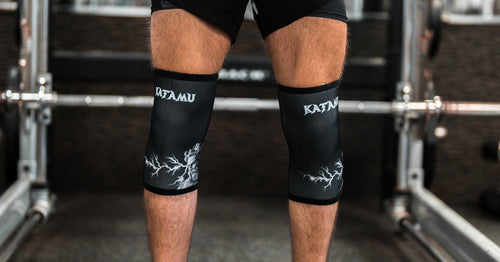
A knee sleeve should sit centered over the knee, covering the joint without bunching behind it. It should feel snug before you even begin your warm-up sets, because sleeves tend to settle as you move and heat up. If it slides down during squats or creates folds that pinch behind the knee, the size or placement is wrong.
Do not treat sizing like a guess. Measure according to the product's sizing guidance, use a flexible tape, and stay honest about your measurements. Sizing down solely to chase a tighter feeling can turn setup into a fight and make training uncomfortable. Sizing up for convenience can leave you constantly pulling the sleeves back into position.
A properly fitted pair will take some effort to put on. That is normal. Turn the sleeve partially inside out, pull it up gradually, and position it over the knee rather than yanking it into place from the top edge. Avoid twisting the material. A clean, even fit feels better and helps the sleeve last.
When to Put Them On During a Session
You do not need to wear knee sleeves from the second you enter the gym. Start your general warm-up, move through light sets, and put them on as your lower-body work becomes more demanding. For some lifters, that is before barbell warm-ups. For others, it is before the first meaningful working set.
Wear them through the exercises where the extra warmth and compression help you feel most confident. That may include your squat work and the first few machine movements. If your session shifts into isolation work and you want more freedom, take them off. There is no prize for wearing every piece of gear for every minute of training.
This is especially useful on powerbuilding days that include both strength and physique work. Save your focus for the lifts that demand it. Your sleeves should support the session, not become another ritual that drains energy before the bar moves.
Build a Smarter Lower-Body Setup
Knee sleeves work best as part of a system. A stable shoe, deliberate warm-up, controlled range of motion, and smart loading are still the foundation. Add a belt when your lift and experience call for it. Use wrist wraps for pressing if they help you stay stacked and secure. Each piece should solve a real training need, not just fill your gym bag.
That is where premium gear earns its keep. Training equipment should survive repeat sessions, keep its shape, and look as serious as the work you put in. Katamu builds lifting essentials for athletes who train with intent, not for people collecting accessories between skipped workouts.
Pay attention to maintenance, too. Let sleeves air out after training instead of leaving them sealed in a damp bag. Follow the care instructions, wash them when needed, and do not let sweat and odor become part of the fabric's permanent identity. Consistent care keeps your gear ready for the next lower-body session.
Signs Your Sleeves Are Not Working for You
A sleeve that constantly rolls, slips, pinches, or cuts off circulation is not giving you a better training experience. Nor is one that has stretched out enough to feel loose by the end of your warm-up. Check your gear with the same honesty you bring to your training log.
You may also need to adjust your expectations. If you only feel confident under load when sleeves are on, use that information to examine the rest of your preparation. Build strong positions, progress patiently, and make the sleeves a reliable layer of support rather than a crutch.
The right pair should disappear into the session once the work starts. You notice the warmth, the secure fit, and the confidence to attack the next set. Then you stop thinking about your knees and start thinking about the rep in front of you.
