 30-Day Money Back Guarantee

You have trained through the prep, hit your opener in warm-ups, and your 7 mm sleeves are packed in your meet bag. Then comes the question that can turn a confident check-in into a problem: are knee sleeves competition legal? Usually, yes. But "usually" does not get white lights, a clean weigh-in, or a spot on the leaderboard.
Competition legality comes down to the rulebook for your exact federation, division, and event. A sleeve that is perfect for heavy squat day can be banned in a raw powerlifting class, restricted at a weightlifting meet, or allowed for workouts but not a final at a functional fitness event. Know the standards before meet week, not while an equipment referee is looking at your knees.
Are Knee Sleeves Competition Legal in Powerlifting?
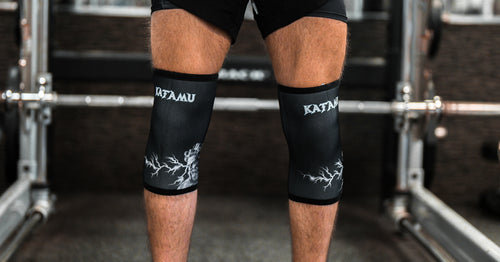
In most powerlifting federations, knee sleeves are legal in raw or classic divisions. They are treated as supportive equipment, not as the same thing as knee wraps. That distinction matters. Sleeves provide compression, warmth, and a stable feeling at the bottom of a squat. Wraps can store more elastic energy and are typically reserved for equipped or wrapped divisions.
The common baseline is simple: sleeves must be neoprene, stay within a maximum thickness, and cannot exceed a maximum length. For IPF-style competition, the familiar standard is a maximum of 7 mm thick and 30 cm long. The sleeves also need to be on the federation's approved equipment list when that federation requires one.
That final point catches lifters every season. A sleeve can be the right thickness and still be non-compliant because its brand, model, logo, construction, or version is not approved. Do not assume a product is legal because teammates wear it at commercial gyms or because it was permitted in a different federation two years ago.
Raw does not mean one universal rule
Powerlifting is not governed by one rulebook. IPF-affiliated meets, USAPL-style competition, USPA events, WRPF meets, and local federations can set different equipment standards. Some require approved brands. Others allow a broader range of sleeves while enforcing measurements. Some divisions allow wraps, while other raw divisions explicitly do not.
Your meet director and current federation technical rules are the authority. Read the rules for the specific meet, not a forum post, a social clip, or an old lifting guide. Federations revise approved lists and technical standards. A rule that was true during your last training block may not be true on meet day.
For a standard raw powerlifting meet, a pair of quality 5 mm or 7 mm sleeves is usually the right lane. The trade-off is feel. A 7 mm sleeve is more rigid and aggressive under a heavy squat, while 5 mm sleeves tend to offer easier movement and less pressure during long sessions. Legal does not automatically mean ideal for your build, squat style, or comfort under a tight meet-day fit.
Knee Sleeve Rules for Olympic Weightlifting
Olympic weightlifting has a different demand profile. You need knee support that moves cleanly through deep receiving positions, catches, and recoveries. Knee sleeves are commonly permitted, but they must not function as a device that gives an unfair mechanical advantage or creates a hazard.
At sanctioned weightlifting events, equipment standards can address dimensions, materials, and features such as straps, fasteners, or rigid reinforcements. A simple neoprene sleeve is generally far less likely to create issues than equipment with extra securing systems or unusual construction.
The practical move is to choose sleeves that stay in place without limiting the depth of your receiving position. A sleeve that feels unstoppable for a low-bar powerlifting squat may feel slow and restrictive when you are pulling under a clean. Test your competition sleeves during full snatch and clean and jerk sessions, not only during strength work.
CrossFit and Functional Fitness Events: Check the Event Rulebook
Functional fitness competition rules are event-specific. Knee sleeves are often allowed during workouts, especially for barbell-heavy events, but organizers can limit gear for safety, movement standards, or fairness. A local throwdown may allow almost any standard sleeve. A larger qualifier or championship can publish a detailed equipment policy and prohibit certain supports during specific tests.
Do not confuse permitted gear with a strategic advantage. If an event includes running, box jumps, pistols, rope climbs, or high-rep cycling, a very stiff sleeve can become a distraction. It may bunch behind the knee, slide when you sweat, or make repeated flexion miserable. The strongest choice is the sleeve that supports your joints without stealing focus from the work.
If the competition has multiple events, pack a setup that matches the weekend. Thicker sleeves can make sense for a heavy squat or clean ladder. A more flexible option may be better for mixed-modal workouts. Just make sure every item you bring is allowed before you walk onto the floor.
Bodybuilding and Strongman Rules Are Different
In bodybuilding, knee sleeves may be useful during training, pump-up sessions, and backstage preparation, but they are generally not part of an onstage presentation. The judging standard is physique, posing, and presentation. Accessories that cover the legs can interfere with that standard, so always follow the promoter's athlete guidance.
Strongman is less uniform. Many contests allow knee sleeves, and some events permit wraps or other support gear. Others restrict equipment for a particular event, particularly when the movement itself is part of the challenge. A deadlift suit, straps, tacky, sleeves, wraps, and belts can all be governed differently depending on the promoter.
This is where the serious competitor separates training assumptions from competition facts. Ask what is legal for each event. Do not assume that because a belt is allowed, wraps are allowed. Do not assume that because sleeves are allowed for a log press, they are allowed for a loading race.
How to Make Sure Your Sleeves Pass Inspection
Treat equipment inspection like one more part of your training plan. First, identify your federation, division, and meet date. Then read the current technical rules and approved equipment list if there is one. Confirm the exact model you own, not just the company name.
Measure your sleeves before packing. The key checks are usually thickness and overall length, but the rulebook may also cover seams, overlays, straps, branding, and how far the sleeve can extend on the leg. Avoid modified gear. Cutting a sleeve, adding stitching, altering a logo, or trying to force a different fit can turn legal equipment into a failed inspection.
Bring a backup pair if the meet matters. Your preferred sleeves can tear, go missing, or get rejected because you bought an outdated version without realizing it. A second compliant pair takes almost no room in a gym bag and protects months of preparation.
Wear your sleeves in training exactly as you intend to wear them on the platform. Do not wait until meet day to find out that a tight new pair takes five minutes to pull on, pinches at depth, or leaves you gassed before your opener. Break them in through your warm-up progression and learn the fit that lets you brace hard, hit depth, and stay locked into the lift.
The Difference Between Legal Gear and Smart Gear
Knee sleeves are not a shortcut around weak positions, poor knee tracking, or a rushed warm-up. They are a tool. Used well, they can keep your knees warm, improve comfort under load, and make heavy attempts feel more secure. Used blindly, they can hide issues that need better programming, mobility work, technique practice, or recovery.
Choose competition gear with the same intention you bring to your training. Durable construction matters. Consistent compression matters. A fit that stays put under real weight matters. But compliance comes first, because the best sleeve in the world does nothing from the sidelines.
When the bar is loaded and the platform is yours, you should be thinking about the command, the brace, and the lift - not whether your gear will send you back to the warm-up room. Check the rulebook early, train in what you plan to compete in, and let your preparation speak when it counts.
